Date: Thursday 26 – Friday 27 March 2026
Convenor: Space Policy Research Group, EU*Asia Institute at ESSCA School of Management & Georgia Tech Center for Space Policy and International Relations
Venue: Georgia Institute of Technology (Atlanta, GA) & Online via TEAMS (see the programme for the connection links)
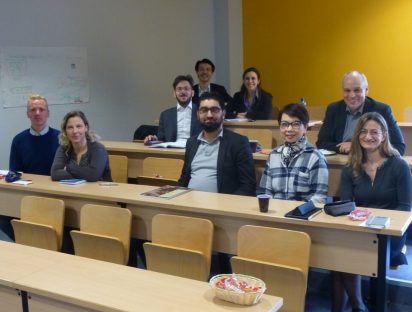
The 18th ESSCA Space Policy Workshop brought together academics and practitioners to discuss key issues related to space governance and space in popular culture. Jointly organised by the Space Policy Research Group of the EU*Asia Institute at ESSCA School of Management and the Georgia Tech Center for Space Policy and International Relations, the event encouraged interdisciplinary discussions that combined legal, political, economic and societal perspectives.
By facilitating dialogue between researchers and professionals, the workshop highlighted the increasing significance of cultural narratives and governance frameworks in shaping the future of space activities and policies on an international scale.
The workshop is part of the activities of the Centre of Excellence Jean Monnet “STARS – European Space Policy: Taking Europe to the Stars”, which is co-funded by the European Union and contributes to the development of cutting-edge research and dialogue on strategic space-related issues.
The workshop opened with introductory remarks by Mariel Borowitz and Thomas Hoerber highlighting the importance of this workshop to strengthen transatlantic academic cooperation.
The first panel, chaired by Mariel Borowitz, focused on the governance challenges in outer space, addressing legal, diplomatic, and economic perspectives. The panel emphasised the need for adaptable and innovative governance mechanisms.
The speakers included:
- Gerard Conway & Peter Jelfs - Brunel University of London
- Bruno Reynaud - University of Minho/JusGov Research Centre
- Ronney Ochieng - Kenya Space Agency
- Qian (Alex) Shi – Secure World Foundation / Purdue University & Ian Christensen - Secure World Foundation
The panel, chaired by Lisa Yaszek (Georgia Tech), explored the implications of various forms of space in popular culture and their influence on civil society’s understanding of space governance. In addition, this panel discussed the challenges associated with aligning national strategies with global cooperation, as well as the public’s comprehension of such dynamics.
The speakers included:
- Harald Köpping Athanasopoulos- 2b AHEAD ThinkTank / EU*Asia Institute
- Andrew Thomas - EU*Asia Institute
- Mika Noh- AI Art Forum
- Antonella Forganni - ESSCA, EU*Asia Institute
The panel, chaired by Thomas Hoerber, discussed the governance and sustainable development of space activities. It addressed specific aspects such as situational awareness and debris mitigation, as well as the role played by both international organisations – ITU – and supranational ones – the EU.
The speakers included:
- Mariel Borowitz - Georgia Institute of Technology
- Pieter van Nes - EU*Asia Institute
- Thomas González Roberts - Georgia Institute of Technology
- Kyah Adams - Embry-Riddle Aeronautical University
The panel, chaired by Harald Köpping Athansopoulos, explored different societal dimensions of space activities at the local level, as well as the multi-stakeholder approach in space activities. The discussion highlighted that space policy is shaped not only by legal and technical considerations but also by social and cultural dynamics.
The speakers included:
- Annie Beckman - New York Law School & Archer Amon – Georgetown University Law Center
- Marie Ileka – Vrije Universiteit Brussels
- Anna Hickey - New York Law School
On the second day of the workshop, Thomas Hoerber chaired a panel that explored the growing influence of private and non-governmental organisations in shaping space governance. The session also covered the evolving policy challenges related to innovation, sovereignty and inclusivity, and it provided valuable insights into the involvement of the private sector in international governance processes.
The speakers included:
- Mary Christine (M.C.) Sungaila - LMU Loyola Law School
- Naciba Chassagnon - ESSCA, EU*Asia Institute
- Daniel Walker - George Washington University & Kelsie Goddard - Texas Christian University
- Shaked Meir Ben Shoushan & Deganit Paikowsky - Hebrew University of Jerusalem
This panel, chaired by Thomas Gonzalez Roberts, focused on the role of culture and imagination in shaping space policy and future developments. The presentations highlighted the role played by AI and new media in space activities, the influence of popular culture on public engagement, the evolving societal role of astronauts, and the importance of foresight approaches in anticipating future developments.
The panel demonstrated how cultural factors contribute to shaping both public perception and policy agendas in space.
The speakers included:
- Shandler Mason - International Space University
- Lorna Ryan - City St George's, University of London
- Jonas Tobiassen - International Space University
- Timiebi Aganaba - Arizona State University
This panel, chaired by Lincoln Hines, addressed governance challenges related to lunar exploration, such as regulatory and policy considerations for emerging space activities, as well as issues such as space debris, and the role of non-state actors in cislunar space.
The panel highlighted the urgency of addressing governance and international coordination in the context of growing interest in lunar missions.
The speakers included:
- Michelle Hanlon - University of Mississippi
- Hatice Elif Yüksel - Space Policy Institute
- Nick Reese - New York University & Annslee Perego & Aaron Mannes - University of Maryland
- Dayana Alagirova - Georgia Institute of Technology
The final panel, chaired by Mariel Borowitz, examined how various regional actors and coalitions shape global space governance and how it increasingly reflects broader geopolitical dynamics, highlighting diversity in institutional models, strategic priorities, and levels of capability.
Overall, the panel emphasised that regional dynamics and differentiated approaches are increasingly shaping global space governance, reflecting varying capacities, interests, and strategic cultures.
The speakers included:
- Fernando Miranda España - Georgia Institute of Technology
- Kathleen Brett - Secure World Foundation
- Francisco Del Canto Viterale - University of North Dakota & Antonio Alejo - The European Union's Multilevel Space Governance Framework
- Helen Kavvadia - University of Luxembourg
The 18th ESSCA Space Policy Workshop provided an important platform for interdisciplinary discussion on space governance and cultural perspectives.
The workshop highlighted:
- the increasing complexity of global space governance
- the importance of international and institutional cooperation
- the role of cultural and societal factors in shaping space policy
The discussions reinforced the importance of academic collaboration in addressing emerging challenges in the global space sector, and contributed to ongoing research and policy developments.

This event is organised within the framework of the Jean Monnet Centre of Excellence STARS, co-funded by the European Union. The views and opinions expressed are those of the authors and do not necessarily reflect the official position of the European Union or the European Education and Culture Executive Agency (EACEA). Neither the European Union nor EACEA can be held responsible for them.