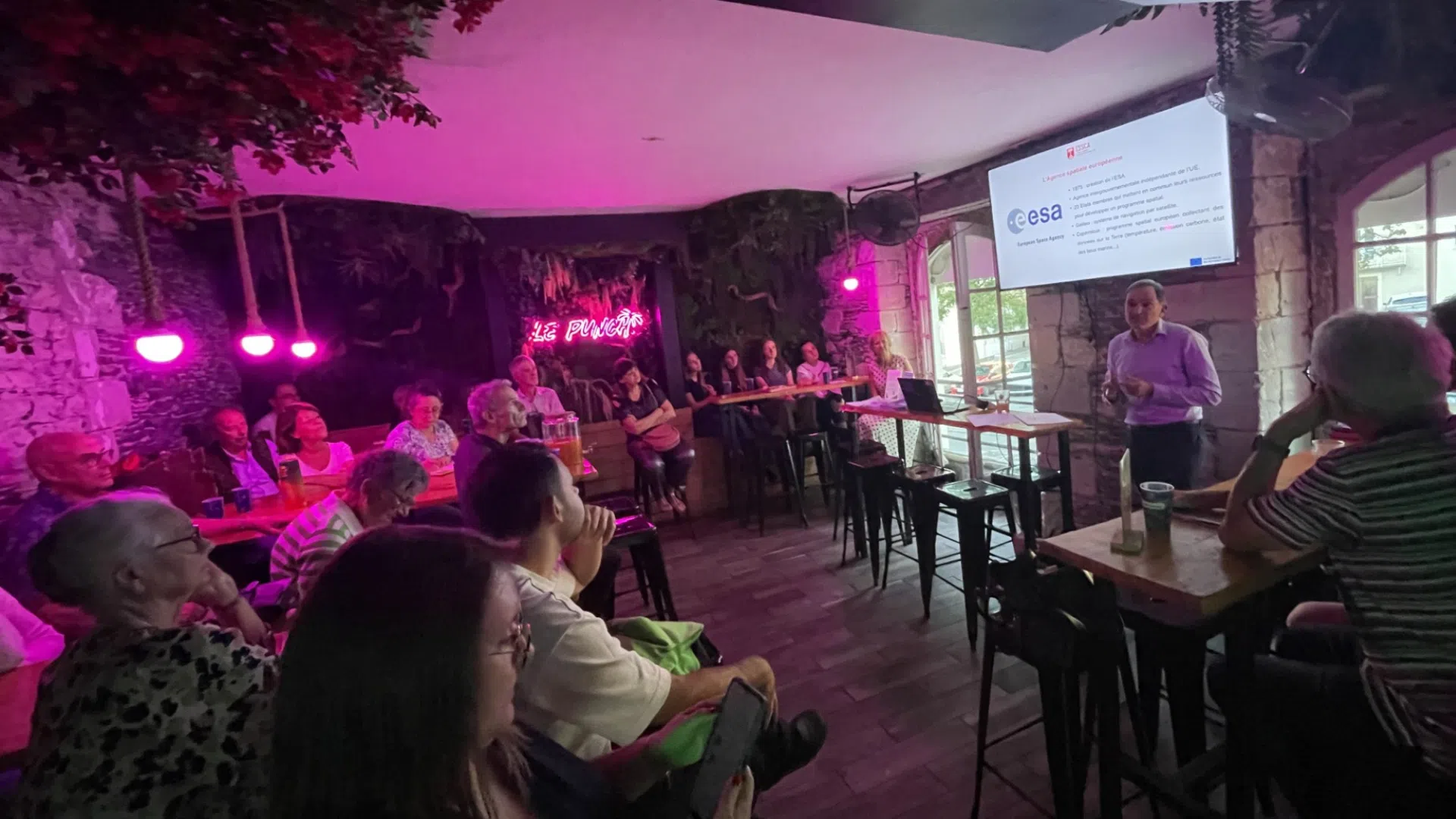
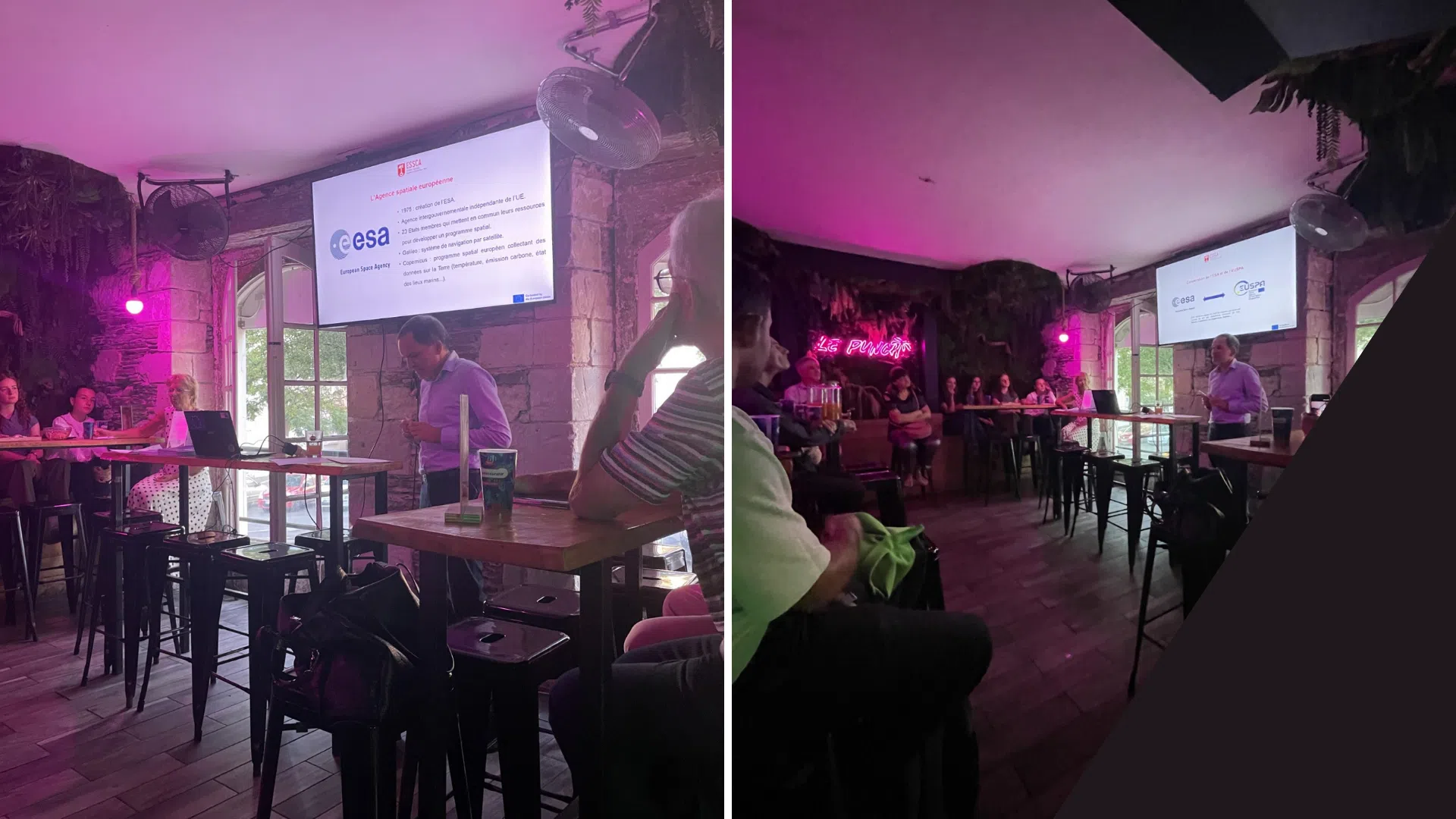
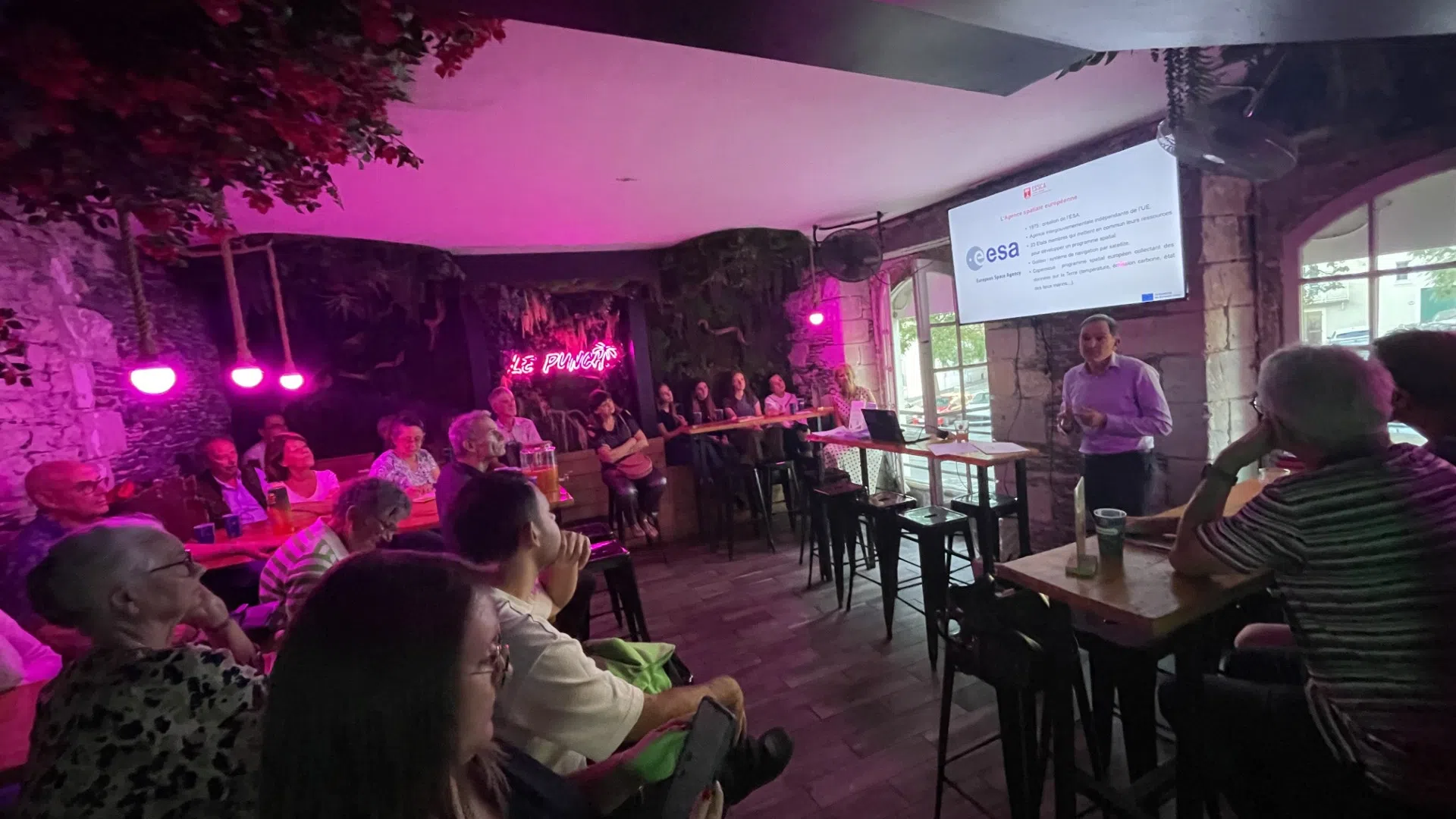
On September 22, 2026, the Jean Monnet STARS Center of Excellence and the Maison de l'Europe Angers & Maine-et-Loire Europe Direct organised a European Café dedicated to European space policy at Le Punch bar in Angers. Moderated by Prof. Thomas Hoerber, director of the EU*Asia Institute at ESSCA, the event brought together about twenty participants from diverse backgrounds, including law students, professionals, and enthusiasts of the space sector.
Open to the general public, this event aimed to raise awareness of the European Union’s space policy, its key players and programs, as well as the challenges associated with developing a competitive, sustainable, and resilient European space sector.
Since the Cold War and the early days of the space race, Europe has been striving to develop its own space capabilities and foster a competitive space industry. This ambition has gradually taken shape through the establishment of institutions and programs that enable European countries to pool their resources and expertise.
The creation of the European Space Agency (ESA) in 1975 marked a major milestone in this cooperation. As an intergovernmental organisation, the ESA is distinct from the European Union and also counts among its members several states that are not part of the EU. European space policy is not, however, limited to the ESA’s activities. As the Union’s competencies in this area have expanded, the EU has established itself as a full-fledged player in space policy.
At the institutional level, this development was reflected in particular by the creation, in 2021, of the European Union Agency for the Space Program (EUSPA). Unlike the ESA, the EUSPA reports directly to the European Union and is primarily involved in the operation of services related to Galileo, the European satellite navigation system.
This rise in the European Union’s influence in the space sector is part of a longer-standing trend. Since the Treaty of Lisbon entered into force in 2009, space has been an area of shared competence between the European Union and its member states. This new framework has helped strengthen European cooperation and the development of major joint programs, including Galileo and Copernicus. The goal is to support scientific and technological progress, consolidate European space programs, and promote industrial competitiveness.
In particular, the event provided an opportunity to clarify the respective roles of the various European institutions in the space sector.
ESA is an intergovernmental organisation funded by contributions from its member states. Although it has its own governing bodies, it does not pursue political objectives. Its primary mission is research, exploration, and innovation in the space sector.
EUSPA, on the other hand, is a European Union agency. Its work is in line with the priorities set by the EU and implemented under the leadership of the European Commission. Among its many missions, the agency manages Galileo’s services, provides in-depth market analysis, and supports research and innovation.
The event also provided an opportunity to showcase two of Europe’s most iconic space programs: Galileo and Copernicus.
Galileo is the European global satellite navigation system. Designed primarily for civilian use, it supports sectors such as transportation, public infrastructure, and search and rescue operations. The Galileo constellation currently consists of 32 satellites in orbit.
Copernicus is the European Earth observation program. It plays a vital role in monitoring the environment and climate change by providing data that is essential for understanding and combating climate change. It is a valuable tool for addressing the extreme weather events already affecting Europe, such as the major wildfires observed in recent years.
The discussions also focused on the EU Space Act. Presented by the European Commission on June 25, 2025, this proposed regulation aims to establish a harmonised framework for space activities within the European Union. It is part of a broader set of measures, known as the “space package,” dedicated to the future of European space policy. The text must now be reviewed by the Council of the European Union and the European Parliament.
This proposal is intended, in particular, to address the fragmentation of national regulations in the space sector, which could hinder the development of a genuine internal market. The aim is to harmonise the applicable rules, to foster the emergence of a single European space market, and to strengthen the competitiveness of European players in the context of growing international competition, particularly with the United States and China.
To achieve these objectives, the proposal is based on three main pillars: resilience, security, and sustainability. The text introduces common standards for space traffic management and sets out measures designed to better address physical and cyber threats to space infrastructure. It also calls for the development of a European methodology to measure and better manage the environmental impact of launches and in-orbit operations.
Thus, the EU Space Act lays the groundwork for a more integrated, sustainable, and resilient European space sector .
The evening concluded with a discussion with the participants on the growing role of private companies in the space sector. Today, commercial operators are launching satellites, providing services, and shaping markets that were once the exclusive domain of government agencies.
This trend can foster innovation and attract new investment, but it also raises questions about dependence on private operators, the regulation of space activities, and the protection of the public interest.
The discussions thus highlighted one of the major challenges facing European space policy: striking a balance between the actions of public institutions and those of private actors, while ensuring that the development of space activities yields benefits for European citizens.

The event also provided an opportunity to showcase the activities of the Jean Monnet STARS Center of Excellence, which is supported by the European Union to strengthen the dissemination of knowledge on European studies and promote dialogue between academia and civil society.

Funded by the European Union. The views and opinions expressed are, however, those of the author(s) only and do not necessarily reflect those of the European Union or the European Education and Culture Executive Agency (EACEA). Neither the European Union nor EACEA can be held responsible for them.