Date: Monday 1 June 2026, 14:00-17:30 CET
Location: online via TEAMS
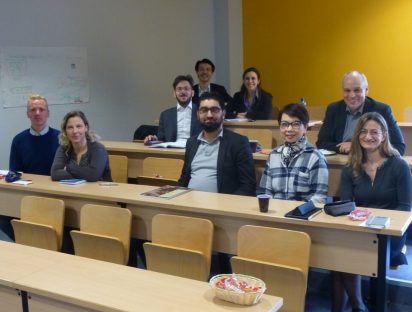
Building on the success of last year's seminar, the EU*Asia Institute at ESSCA School of Management hosted the second Fresh Ideas Seminar on 1 June 2026. Once again, the event provided a platform for innovative and ground-breaking ideas that challenge traditional academic boundaries.
The seminar started with introductory remarks from Professors Antonella Forganni and Gabriel Weber. This provided an opportunity to emphasise the purpose of the Fresh Ideas Seminar: to provide a platform for members of the academic community to discuss potential research subjects and inspire further discussion.
This edition featured a rich, multidisciplinary programme:
Andrew Thomas - EU*Asia Institute
Lunar laissez-faire: A perspective on Lunar exploration
Andrew Thomas' presentation addressed the challenges and opportunities arising from lunar exploration. It highlighted the need for the international community to define the Moon's territory and the laws to which it would be subject, because this exploration creates value out of need, and contract-binding projects could be developed by various countries. The presentation also prompted discussion about a new market: lunar tourism.
Regis Bonnant - ESSCA School of Management
The Prevention, Management and Resolution of Disputes in the Hotel Industry: A Comparative Analysis of Corporate Legal Strategies and Dispute Resolution Practices
Régis Bonnan’s presentation summarised his ongoing PhD research. It discussed disputes between owners, managers, franchises and leases. The research aims to study the main causes, legal basis and consequences of contract termination in the hospitality industry.
Camilla Villard-Duran - ESSCA School of Management & EU*Asia Institute
Rearticulating Cooperation: The Bank for International Settlements and the Discursive Construction of Global Monetary Governance
In her presentation, Professor Villard-Duran analysed a longitudinal discursive study of the Bank for International Settlements (BIS) based on its annual reports from 1931 to 2025. Her analysis examined how, following global financial crises, cooperation is reframed and reinforced as a matter of collective responsibility for systemic stability.
Christopher Williams - ESSCA School of Management & EU*Asia Institute
Analyzing African Presidential Speeches using a Large Language Model
In his presentation, Prof Williams proposed using large language models to analyse presidential speeches. The aim is to analyse the impact of leaders' narratives. The purpose of presidential speeches is twofold: on the one hand, to assert control, and on the other, to motivate voters. However, the main purpose of speeches is to attract capital.
Leonardo Talero - Autonomous University of Bucaramanga, Colombia & Gabriel Weber - ESSCA School of Management & EU*Asia Institute
Benchmark Transmission, Environmental Stress, and Smallholder Resilience in the Cocoa Supply Chain: Evidence from Santander, Colombia
The presentation focused on the cocoa market, using Santander in Colombia as a case study. Leonardo Talero discussed how various territorial stresses were incorporated into the proposed statistical model, which was intended to facilitate the estimation of buffer capacity and resilience among farmers facing these factors.
Davide Esposito - University of Naples Parthenope, Italy
Bioeconomy, Climate and Sustainability in Italy: Insights from the EU Monitoring Framework
Davide Esposito discussed how the bioeconomy relies heavily on the stability of natural ecosystems, while also contributing to climate solutions. He highlighted that the Italian bioeconomy is a unique combination of historical and innovative sectors, but that its geographical distribution is uneven; with an industrial sector in the north and primarily natural capital in the south.
In conclusion, this year's Fresh Ideas Seminar encouraged scientific discussion and the exchange of perspectives. The variety of topics covered also provided an opportunity to discuss various research methodologies.
Click here to download the programme (.pdf)