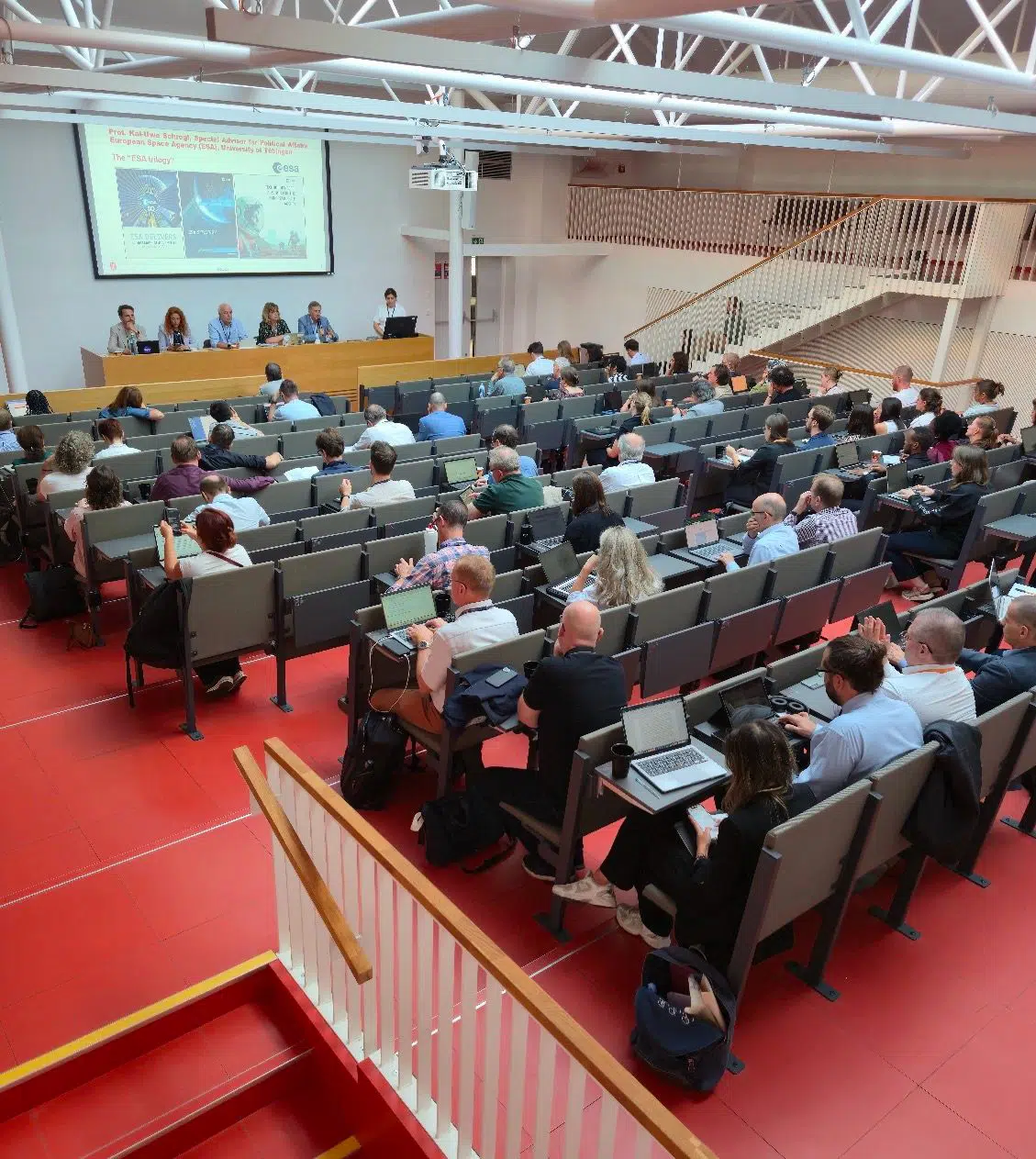
From 7 to 9 September 2026, UACES (University Association for Contemporary European Studies) held its 56th annual conference in Prague. A leading academic association in the field of European studies, UACES brings together several hundred European studies scholars every year.
As a long-standing partner of the association, ESSCA's EU*Asia Institute played a leading role. Thanks to the multidisciplinary nature of its research, its members contributed their expertise on European space policy and on the European Union's sustainability policy, and showcased the research of the Jean Monnet Centre of Excellence, STARS.
UACES offers an opportunity for dialogue between researchers and doctoral students through thematic sessions and plenary conferences. The Institute's involvement is part of a lasting relationship with UACES, whose next annual conference will be held in 2027 on ESSCA's Bordeaux campus.
A Strong Focus on European Space Issues
European space policy was one of the main areas of contribution from the EU*Asia Institute at this edition.
Professor Thomas Hoerber chaired the sessions European Space Policy I and European Space Policy II, which focused on the strategic, security and legal issues of European space policy. These discussions brought together several members of the Institute to address European defence, space governance and future human activities on the Moon.
European Space Policy I – Space Between Diplomacy and Militarisation
For decades, Europe has been among the leaders in space policy, possessing nearly all of the necessary capabilities. What was once the preserve of engineers, experts and enthusiasts has become a major axis of European public policy. The themes addressed during this session, the militarisation of space, space as a diplomatic tool, the commercialisation of space by private actors, and space as a means of facilitating European defence, fall within the scope of ESSCA's research group on space policy.
Human involvement in space has had a growing impact on its militarisation. The shift in the international order and rising conflicts require the mobilisation of every tool available to states.
Thomas Hoerber presented the new threats currently facing the European Union. They are of two kinds: first, the Russian threat is evident and is unfolding in Ukraine; second, the transatlantic link is weakening and has become less reliable, to the point that the European Union must rethink its security arrangements. This leads to a European defence bringing together those who wish to take part and have the means to do so, and therefore to differentiated integration as the established way forward. The Russian threat appears to concern first and foremost those Member States that experienced Soviet domination. Are they sufficiently united? Will the traditional leaders of Western Europe accept their emancipation and, if so, how will they be able to help them?
European Space Policy II – Space Exploration: Between Public and Private Actors
The Institute's members continued their reflection during European Space Policy II, in a discussion on the growing involvement of private actors in space policy.
In light of the growth of private actors in space, Antonella Forganni presented a study on the obstacles to harmonising the private law of space activities and possible solutions for creating an international normative framework. European law appears to be fertile ground for establishing a space protocol destined to become international. Drawing on the recent EU Space Act and on the Union's experience in harmonising insolvency law, the EU could serve as an intermediate normative step before the adoption of a truly international instrument. Lorna Ryan discussed the role of the EU's advisory bodies in the face of increasingly centralised power. There are two EU advisory bodies: the European Economic and Social Committee and the Committee of the Regions. They represent European society and issue non-binding opinions on policy and legislation.
Investment in space is taking place at every level, with various projects attracting numerous private and commercial actors. Pieter van Nes presented his reflections on sustainable human settlements on the Moon and the European prospects of the Moon Village project. He contrasts Europe's decentralised approach, shared between the ESA, the European Union and national governments, with the centralised strategies of the United States and China, and examines what this implies for Europe's ability to act coherently in space exploration. Harald Köpping Athanasopoulos focused on the emergence of cislunar space. This zone between the Earth and the Moon, which offers the benefits of both proximity to Earth and lunar gravity, is crystallising international rivalries.
The EU is at a crossroads. Space policy can strengthen European integration, but international conflicts are leading to a gradual militarisation of space, which clashes with the diverging views of the Member States. Moreover, European space policy is a means of consolidating the Union's sovereignty and independence from the American companies that have moved into the space sector.
A Plenary Conference on the Future of European Space Policy
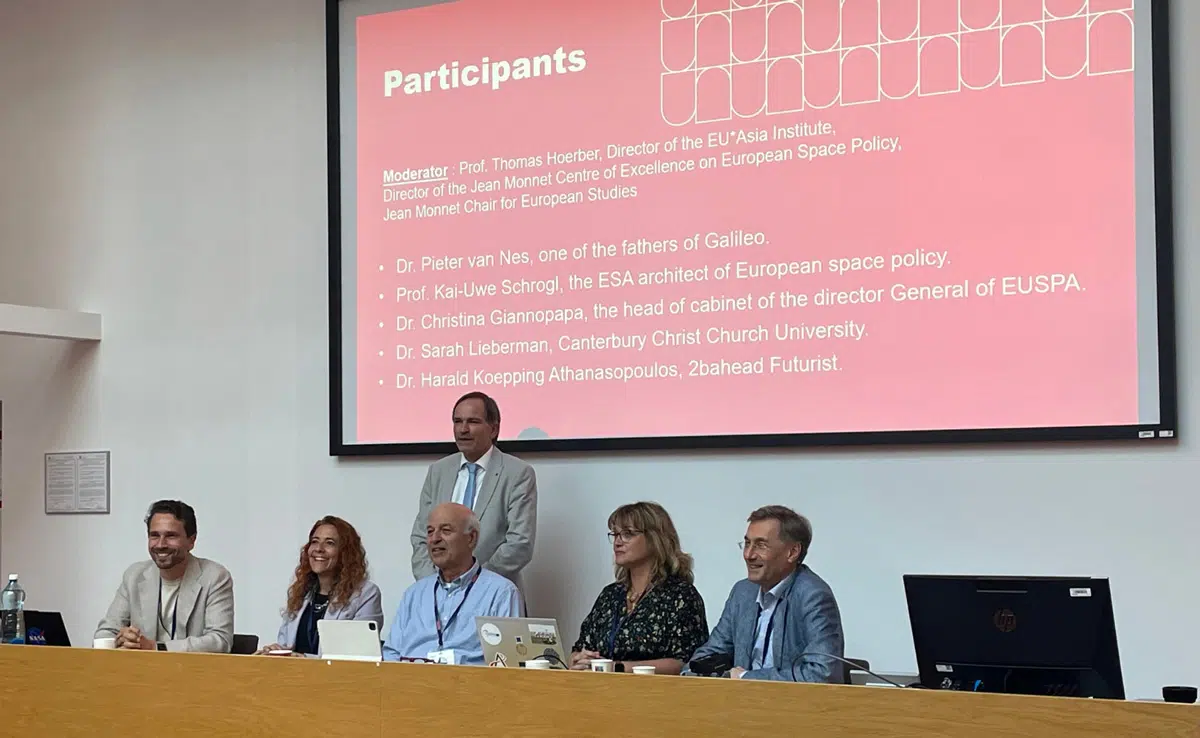
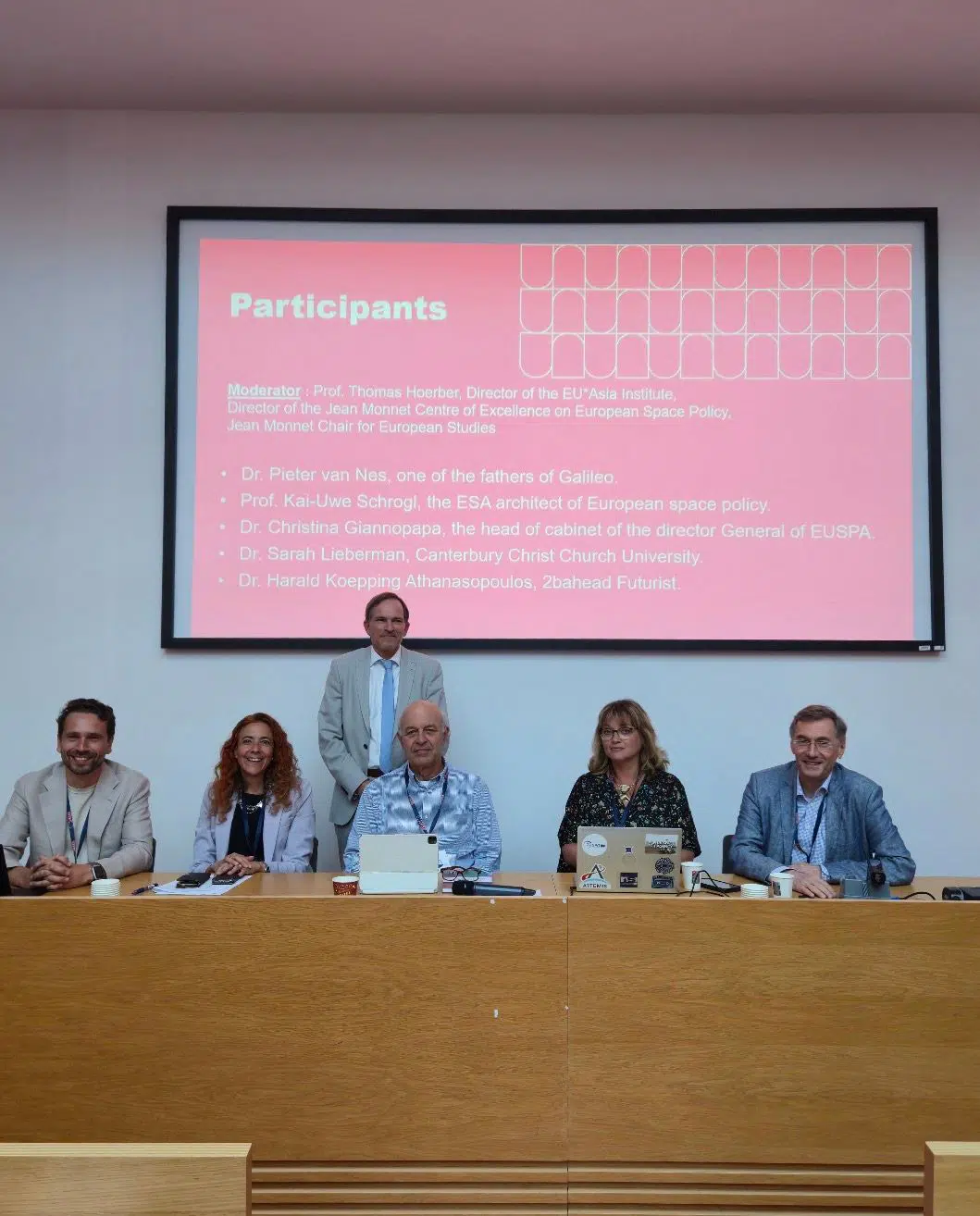
As a highlight of the conference, the EU*Asia Institute organised the plenary session "Europe and the Future of Space Policy", moderated by Thomas Hoerber.
The session brought together several major figures from the European space sector: Pieter van Nes; Kai-Uwe Schrogl (Special Advisor for Political Affairs, ESA); Christina Giannopapa (Chief of Staff to the Executive Director, EUSPA); Sarah Lieberman (Senior Lecturer at Canterbury Christ Church University); and Harald Köpping Athanasopoulos (Head of Future Intelligence at 2b AHEAD ThinkTank).
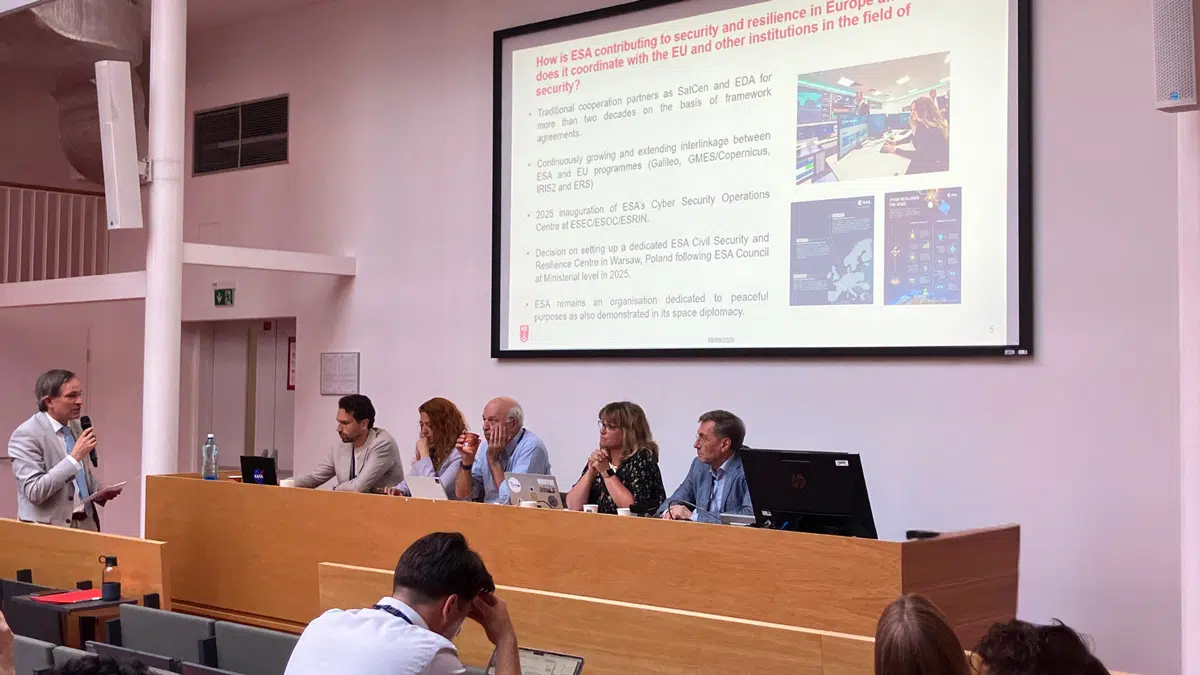
The discussions addressed the profound transformations of European space policy, including the role of the ESA and EUSPA in building up the Union's space capabilities.
The ESA actively contributes to European security and resilience by creating new infrastructure to that end and by widening the scope of European cooperation. As for EUSPA, it works to secure orbital infrastructure and to advance space governance, continuing to adapt to geopolitical shifts and the gradual militarisation of space.
The speakers highlighted Europe's growing role as a normative actor in this field, while pointing to the challenges relating to its strategic autonomy and to the protection of its critical infrastructure, since the militarisation of space and the involvement of private actors show no signs of slowing down.
Euroglopaedia: Making European Studies Accessible to All
The EU*Asia Institute also used UACES 2026 to present one of its flagship initiatives under its Jean Monnet Centre of Excellence STARS: Euroglopaedia.
Chaired by Thomas Hoerber, the session dedicated to this project highlighted the ambition of creating a leading digital encyclopaedia devoted to European studies. The aim of this project is to create a universal online encyclopaedia on European Studies and to become a reference in the academic field as well as among the general public.
This initiative illustrates the Institute's commitment to spreading knowledge and bringing academic research closer to society.
From the Circular Economy to Local Governance: The European Green Agenda in Practice
The EU*Asia Institute's contributions were not limited to space policy.
In the sessions devoted to the European Green Agenda, Thomas Hoerber chaired several discussions on the regulatory challenges of the ecological transition.
Marjorie Tendero presented a comparative study of urban composting policies in France and Germany. The research analyses how local authorities implement EU circular economy objectives through the coordination of regulatory frameworks, infrastructure and citizen participation.
The findings underline the importance of effective multi-level governance in encouraging the sustainable adoption of composting practices and in translating the European Union's environmental ambitions into concrete action.
UACES Bordeaux 2027: A New Stage in a Long-Standing Partnership
The Prague conference closed with a major announcement for ESSCA: the 57th UACES annual conference will be held in 2027 on the Bordeaux campus.
This selection extends a longstanding collaboration between ESSCA and UACES. In 2009, the school had already hosted the association's 39th annual conference in Angers, becoming the first French institution to organise this landmark event in the field of European studies.
Since then, the EU*Asia Institute has continued its engagement within the network through numerous scientific collaborations, international projects and academic contributions. Hosting UACES 2027 in Bordeaux is thus a recognition of the role played by the Institute in the development and international standing of European studies.
This upcoming edition will give ESSCA the opportunity to once again bring together researchers, experts and decision-makers around the major issues that will shape Europe's future.