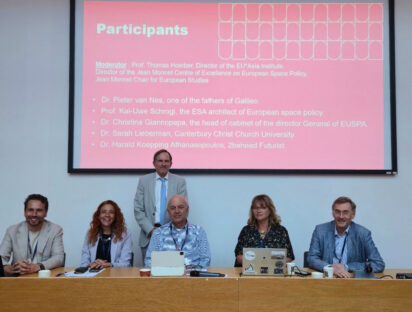
This conference, organised as part of the JECO OFF on 4 November 2025, took place at the ESSCA Lyon campus in a hybrid format. The session brought together ESSCA professors and EU*Asia Institute members Thomas Hoerber, Marjorie Tendero and Christoph Weber, who shared insights connected to their published edited volumes, ‘The European Environmental Conscience in EU Politics. A Developing Ideology’ (Routledge, 2022) and ‘The European Environmental Conscience in the EU - Finance, Innovation, and External Relations’ (Routledge, 2025). The event offered a dynamic exchange based on the conceptual perspectives and case studies of these volumes.
Professor Thomas Hoerber opened the conference with an overview of how the European Environmental Conscience (EEC) has developed over time. He explained that although the EU began as an energy community focused on post-war industrial recovery, rising environmental concerns in the 1960s and 1970s gradually led to the inclusion of environmental protection in EU law.
Major treaty milestones such as the Single European Act (1987), the Maastricht Treaty (1992), and the Amsterdam Treaty (1997) highlighted the growing recognition of environmental responsibilities at the EU level. Professor Hoerber defined the EEC through four key characteristics that appear throughout the Routledge volume:
- the strong connection between energy and environmental policy,
- public demand for sustainable solutions,
- the legitimacy of European Commission leadership, and
- a continuous focus on innovation and progress in policy development.
Building on this foundation, Professor Marjorie Tendero demonstrated how the EEC has shaped new areas of EU governance, including green finance, technological innovation and external relations. These policy fields, initially independent of environmental concerns, now reflect the EU’s broader commitment to sustainability. Examples included the integration of environmental clauses into trade agreements, the EU’s active role in climate diplomacy, and the increasing number of climate-related conditions in development cooperation.
These themes are central to the 2025 edited volume, which illustrates how environmental principles are reshaping both internal and external policy settings of the EU.
Professor Tomasz Braun, one of the contributors to the latest book, made a significant contribution to the discussions Drawing on his chapter in the book 'Financial Enforcement Instruments of Sustainability ', Professor Braun demonstrated how banking regulation, supervisory systems, and financial market mechanisms can support and accelerate the EU’s climate transition by steering investment and compliance. His contribution underlined the practical application of the EEC within the financial system, linking the conceptual discussions to concrete institutional and economic instruments.
Professor Christoph Weber concluded by presenting the changing role of the European Central Bank (ECB) in sustainability governance. Although the ECB’s primary mandate remains price stability, the bank has increasingly incorporated climate considerations into its operations by conducting climate stress tests, integrating green criteria into bond purchase programmes and participating in EU sustainable finance initiatives. Professor Weber also emphasised the impact of societal actors and civil society campaigns in shaping monetary responses, highlighting the multi-level nature of the ECB.
This session demonstrated how the European Environmental Conscience has evolved from a growing awareness of environmental degradation in the 1970s into a cross-sector framework influencing EU governance, international positioning, financial regulation, and political identity. The strong alignment between the conference and the 2025 Routledge volume provided a consistent academic narrative, showing how sustainability has become a defining dimension of European integration.
Date: Tuesday 4 November 2025, 16h30-18h30
Venue : Campus ESSCA Lyon - Amphi 001, 4 pont Pasteur, 69007 Lyon
Speakers
Thomas HOERBER, Professor at ESSCA School of Management, Angers
Marjorie TENDERO, Professor at ESSCA School of Management, Angers
Christoph WEBER, Professor at ESSCA School of Management, Lyon

This conference was organised as part of JECO 2025 – Les journées de l'économie – Lyon, 4 to 6 November 2025.